Other Publications
Advance Decision on Life-sustaining Treatment Ordinance
The rapid ageing of Hong Kong’s population underscores the need to improve end-of-life (“EoL”) care services, amidst mounting challenges. The Government’s policy objective is to provide high-quality and comprehensive EoL care services to patients and their families in accordance with their wishes and needs, ensuring that patients receive suitable EoL care. Our aim is to shield patients from enduring ineffective and unnecessary treatments in their last days, enabling them to uphold their dignity as they conclude their life’s voyage.
Thus, the Government introduced the Advance Decision on Life-sustaining Treatment Ordinance (“the Ordinance”), with a view to establishing corresponding legal frameworks for advance medical directives (“AMDs”) and do-not-attempt cardiopulmonary resuscitation (“DNACPR”) orders and providing legal protection to patients, healthcare professionals, as well as rescuers, where terminally ill patients are empowered with a greater degree of autonomy. The Ordinance was passed at the Council meeting on 20 November 2024 and gazetted on 29 November 2024. The Ordinance will come into operation on 31 July 2026.
AMD
An AMD allows an adult patient, while he or she is mentally capable of deciding on a life-sustaining treatment (“LST”), to indicate in advance the LST(s) that he or she wishes to refuse under specified clinical circumstances (i.e. the specified precondition(s) under the Ordinance), so as to ensure that the patient's previously expressed treatment wishes will be respected should the patient subsequently lose mental capacity as a result of deterioration in his/her condition. The making of an AMD is guided by the principle of “cautious making”, under which the maker must fully understand and carefully weigh the implications of each instruction in the AMD, and make an informed and voluntary decision after thorough discussion with family members and healthcare professionals. To facilitate patients who need to make an AMD that complies with the requirements of the Ordinance, the Ordinance provides model forms for their use. AMDs made before the Ordinance commences will remain valid provided that they comply with the conditions stipulated in the Ordinance and all instructions therein are presented in a clear way. For example, AMDs made before the commencement of the Ordinance using the [model forms] under Schedule 2 to the Ordinance, as well as AMDs previously made using the Hospital Authority's (“HA”) forms, already comply with the requirements of the Ordinance.
Apart from the existing paper AMDs, the Government will progressively introduce electronic AMDs (“eAMDs”), with the Electronic Health System (“eHealth”) serving as the designated electronic system to support the making, storage, viewing and revocation of eAMDs. The Government will implement paper AMDs and eAMDs in phases. In the first phase, only paper AMDs as well as the electronic storage, viewing and revocation of such AMDs will be implemented. Once the relevant functions of eHealth are in place, the Government will enable the electronic making of AMDs directly in the system. The first phase of eAMDs will take effect when the Ordinance commences, and patients who have already made a paper AMD may choose whether to store their AMD electronically. Once an AMD is stored in eHealth, the patient and authorised public and private healthcare institutions may access the eAMD through eHealth. If a patient wishes to store a paper AMD in eHealth, the uploading must be assisted by a registered medical practitioner (“RMP”), so that the RMP can first review the AMD and confirm that it complies with the requirements stipulated in the Ordinance. Relevant information is available at https://app.ehealth.gov.hk/ehealth-pro-faq.
Likewise, based on the principle of “cautious making”, an AMD does not take effect immediately upon being made, nor does it apply in all circumstances. An AMD will only apply when the patient is mentally incapable of deciding on an LST and the specified precondition(s) set out in advance in the AMD are met, at which point healthcare professionals will follow the patient's wishes and withhold or withdraw the pertinent LST(s). This arrangement mainly ensures that the decision to withhold or withdraw an LST is one that the maker had anticipated and understood at the time of making the AMD.
Revocation is guided by the principle of “easy revoking”. As long as the patient is mentally capable of deciding on an LST, he/she may change his or her wishes at any time and revoke an AMD that has been made by various means (such as in writing, verbally, by destruction of the instrument, or through eHealth).
DNACPR Order
Since an AMD only applies under specified precondition(s), it is difficult for rescuers (such as ambulance crew or lay persons who have received first-aid training) to determine on the spot whether the person-in-arrest has already met the specified precondition(s) in the absence of healthcare professionals. RMPs will therefore, having regard to the patient's medical condition, issue a DNACPR order to a patient who has met the specified precondition(s), specifying that no person shall perform cardiopulmonary resuscitation (“CPR”) on that patient under applicable circumstances. DNACPR orders fall into two main categories: AMD-based DNACPR orders and non-AMD-based DNACPR orders, which differ in respect of the persons for whom they may be issued, their purpose, issuance requirements and revocation arrangements.
AMD-based DNACPR orders apply to adult patients who have made an AMD specifying refusal of CPR, so as to ensure that rescuers can act in accordance with the patient's autonomous wishes previously expressed and withhold CPR. An AMD-based DNACPR order must be issued by two RMPs (at least one of whom must be a specialist), and may be revoked by two RMPs crossing out the contents and signing every page of the order. Based on the principle of “easy revoking”, as long as the patient is mentally capable of deciding on an LST, he or she may also revoke the DNACPR order by various means (such as in writing, verbally, or by destruction of the order). If the patient revokes the underlying AMD, the AMD-based DNACPR order issued pursuant to it is thereby revoked.
Non-AMD-based DNACPR orders apply to minors and adults who are mentally incapable of deciding on an LST, neither of whom is eligible to make an AMD. As these patients are unable to make an autonomous decision, RMPs will decide whether to issue a DNACPR order based on their assessment of the patient's best interests. If the patient's attending RMP and family members reach a consensus that performing CPR would not be in the patient's best interests, the attending RMP may issue a non-AMD-based DNACPR order for the patient, and a responsible person (such as a family member or guardian) must indicate agreement with the RMPs' judgment and co-sign the order. A non-AMD-based DNACPR order may only be revoked by two RMPs (at least one of whom must be a specialist) crossing out the contents and signing every page of the order. In addition, when the adult patient regains mental capacity or a new DNACPR order is issued, the original order is automatically revoked. The order is also automatically revoked once the patient concerned attains the age of 18.
A DNACPR order must be issued in writing using the paper [prescribed forms] under Schedule 3 to the Ordinance to facilitate identification and verification. An order not made in this form will be invalid. No electronic version is available for DNACPR orders. For existing DNACPR orders issued before the Ordinance commences, they must be replaced with an order using the prescribed forms in order to remain valid.
Download Forms
The model forms of AMD are provided in Schedule 2 to the Ordinance. The Government encourages the members of the public to adopt model forms to make AMDs, ensuring that all instructions in the AMD are clearly presented and comply with legal requirements. The prescribed forms of DNACPR order and continuation sheets for extension of the effective period are included in Schedule 3 to the Ordinance. These forms and continuation sheets are currently available for download on the Health Bureau website and are listed below for public use-
| Form No. | Description | |
|---|---|---|
| Schedule 2: Model Forms of Advance Medical Directive (AMD) | ||
| 1 | AMD |  (Chinese)(318KB) (English)(337KB) (Chinese)(318KB) (English)(337KB) |
| 2 | AMD (For Refusal of Cardiopulmonary Resuscitation Only) | (Chinese)(353KB) (English)(174KB) |
| Schedule 3: Statutory Forms and Continuation Sheets of Do-Not-Attempt Cardiopulmonary Resuscitation (DNACPR) Order | ||
| 1 | DNACPR order (AMD-based) | (Chinese)(352KB) (English)(197KB) |
| 2 | DNACPR order (not AMD-based) (For Mentally Incapable Adult) | (Chinese)(528KB) (English)(239KB) |
| 3 | DNACPR order (not AMD-based) (For Minor) | (Chinese)(336KB) (English)(215KB) |
| 4 | Continuation Sheet for DNACPR order (For Adult) (Applicable for Statutory Form 1 & 2) |
(Chinese)(151KB) (English)(42KB) |
| 5 | Continuation Sheet for DNACPR order (For Minor) (Applicable for Statutory Form 3 only) |
(Chinese)(148KB) (English)(43KB) |
Frequently Asked Questions:
Q1. What does LST include for the purpose of an AMD, which enables patients to refuse LST under certain specified precondition(s)?
LST refers to a variety of medical treatments that potentially postpone a patient’s death and includes, for example, CPR, artificial ventilation, blood products, pacemakers, vasopressors, specialised treatments for particular conditions (such as chemotherapy or dialysis), antibiotics when given for potentially life-threatening infection, and artificial nutrition and hydration (i.e. the feeding of food and water to a person through a tube). Through an AMD, makers can refuse one or multiple LSTs.
If providing the LST would not be in the terminally ill patient’s best interests or the patient has expressed his/her wishes to refuse the LST, withholding or withdrawing the LST is ethical and legal. However, AMDs do not extend to the refusal of basic care (e.g. offering food and drink to the patient for the patient’s consumption by mouth and assisting the patient in consuming food and drinking by mouth) or palliative care. Healthcare professionals should continue to provide basic care and palliative care to patients to address their basic survival needs.
Q2. Who is eligible to make an AMD?
Only an adult who is mentally capable of deciding on an LST can make an AMD to indicate his/her wishes for refusing LST(s) (such as CPR) when he/she reaches the specified medical condition(s) (e.g. being terminally ill; being in a persistent vegetative state or a state of irreversible coma; or being in other end-stage, irreversible, life-limiting condition). Since an AMD is a medical decision made by a patient of his/her own volition, the Ordinance upholds the principle of “cautious making, easy revoking”. “Cautious making” means ensuring that the maker makes an informed decision after having fully understood and carefully weighed the implications of each instruction (i.e. not performing the specified LST(s) when the specified precondition(s) is/are met) on his/her own condition. The Ordinance therefore sets out a number of statutory requirements which must be complied with in the making process. An AMD will only apply under specific circumstances (i.e. where the maker is mentally incapable of deciding on an LST and the specified precondition(s) is/are met), so as to ensure that the decision not to provide or to withdraw LST(s) is/are one which the maker had anticipated and understood when making the AMD.
Given that minors and adults who are mentally incapable of deciding on an LST cannot make AMDs, attending RMP may make a non-AMD-based DNACPR order for them if a consensus is reached among the patient’s attending RMP and family members that CPR would not be in the patient’s best interests. A DNACPR order instructs not to perform CPR on the subject patient under applicable circumstances when that person is in a cardiopulmonary arrest. A responsible person (such as a family member or guardian) must indicate agreement with the RMP's judgment and co-sign the order.
Q3. Does an AMD only apply to terminally ill patients? Can healthy individuals make an AMD?
The main purpose of an AMD is to allow adult patients suffering from advanced and irreversible disease, while they are mentally capable of deciding on an LST, to indicate in advance the LST(s) that they wish to refuse should they subsequently lose mental capacity and the specified precondition(s) set out in the AMD (such as suffering from a terminal illness) are met. Although the Ordinance does not preclude healthy individuals from making an AMD, based on the principle of “cautious making, easy revoking” and in accordance with the Best Practice Guidelines on Advance Medical Directives published by the Hong Kong Academy of Medicine, it is not advisable for healthy individuals to make an AMD prematurely for a terminal illness that may arise in future. This is because a terminal illness may arise from a wide range of causes, and different LSTs have different effects on different diseases. A person's values regarding life and his/her acceptance of disability, before falling ill, may also differ greatly from those held after falling ill. Furthermore, most terminally ill patients, at the time of being diagnosed with a serious illness, are still mentally capable of acting and of making decisions on their treatment plan. We therefore recommend that healthy individuals should familiarise themselves with advance care planning and AMDs at an early stage, so that they will find it easier to discuss such matters with healthcare professionals should they fall ill in future.
Q4. Does an AMD have to be made in model forms?
We encourage the members of the public to adopt model forms provided in Schedule 2 to the Ordinance when making AMDs, ensuring that all instructions in their AMDs are clearly presented and comply with legal requirements (e.g. the maker is an adult who is mentally capable of deciding on an LST; all instructions in the AMD are presented in a clear way; the maker of the AMD signs the directive in the presence of not less than 2 witnesses; both witnesses, to the best of their knowledge, are not interested persons of the maker; one of the witnesses is an RMP; the other witness is an adult, etc.)
The model form provides three specified preconditions for the maker to choose from under the advice of the witnessing RMP. An AMD will be applicable when the patient falls into the specified precondition(s) specified in the instructions and becomes mentally incapable of deciding on an LST. The three specified preconditions provided in the model forms are as follows :
| 1. | Being terminally ill (i.e. the patient suffers from an advanced, progressive and irreversible medical condition with a short life expectancy in terms of days, weeks or months, where any form of LST would only serve to postpone the person’s death); |
| 2. | Being in a persistent vegetative state and state of irreversible coma; or |
| 3. | Being in other end-stage, irreversible, life-limiting condition (distinct from the above two categories, specifying the medical condition of the patient is progressive and irreversible and has reached its end-stage and limits the survival of the person), for example, a patient with end-stage renal failure, end-stage motor neuron disease, or end-stage chronic obstructive pulmonary disease. Where these patients may receive dialysis treatment or assisted ventilation to prolong life, such conditions are not categorised as the first category. [Note: Patients suffering from end-stage dementia will be categorised as the third category.] |
The Ordinance allows members of the public to adopt non-model forms for making AMDs, provided that the instructions in the AMD are clearly presented and comply with legal requirements. Individuals intending to adopt non-model forms are advised to consult RMPs beforehand, ensuring a clear presentation of the specified precondition(s) in accordance with legal requirements.
Q5. Is it a statutory requirement for members of the public who have made a paper AMD to make an eAMD? What are the benefits of making an eAMD?
Making an eAMD is purely a voluntary choice. Members of the public may continue to make and keep an AMD solely in paper form, and its legal effect is the same as that of the electronic version.
The main benefit of making an eAMD is to provide members of the public with additional convenience, sparing the maker and family members the hassle of carrying the paper document, while enabling healthcare professionals to access it even in emergency situations. Once a patient has uploaded and stored an eAMD on eHealth, authorised healthcare professionals registered with eHealth will be able to promptly ascertain whether the patient has made an AMD and access the electronic record of the AMD, thereby enabling them to make appropriate clinical judgments when providing medical services.
It is worth noting that if a patient keeps both a paper AMD and an eAMD, should the patient's wishes change, the patient must ensure that the paper AMD, the eAMD, and all validating copies (such as certified true copies certified by an RMP or a solicitor practising in Hong Kong) are revoked, so as to avoid unnecessary confusion or disputes when healthcare professionals act on the AMD in future.
Q6. For pre-existing AMDs and DNACPR orders made before the commencement of the Ordinance, are they required to be remade after the commencement?
Generally, pre-existing AMDs made before the commencement of the Ordinance will continue to be valid, as long as they comply with the requirements as stipulated in the Ordinance and the instructions in the AMD are clearly presented. As an illustration, a pre-existing directive made in an HA form should have met the requirements of clearly presenting all instructions specified in the Ordinance.
For pre-existing AMDs which are clearly presented but do not fully comply with all the requirements of the Ordinance, if an RMP agrees that it is not in the patient’s best interests to administer the LST(s) that is/are refused in the AMD, the RMP may withhold LST(s) from the patient on the basis of the patient’s AMD under common law, which is made outside Hong Kong. Nevertheless, we recommend members of the public, who have made an AMD, to regularly review their AMD with RMPs and update or modify the instructions, if appropriate, by using the model forms specified in the Ordinance.
DNACPR orders issued before the Ordinance commences must be replaced with the prescribed forms provided in the Ordinance in order to remain valid.
Q7. Is there a limit on the number of times for making AMDs?
Given that AMDs pertain to life-and-death decisions, makers should exercise prudence when making an AMD, and keep records properly if there arises a need to revoke or remake the AMD. This practice helps avoid confusion for medical professionals in performing their duties.
Q8. An AMD must be made in the presence and with signature of two witnesses. What requirements should such two witnesses meet? Can the patient’s family members or carers serve as a witness?
One of the witnesses must be an RMP registered in Hong Kong and not an interested person of the maker. He/she has to undertake the following three responsibilities:
| 1. | Explaining to the maker the nature and content of AMD, as well as the effect of following each of the instructions in the AMD on the maker; |
| 2. | Being satisfied that, at the time when the maker signs the directive, the maker is mentally capable of deciding on an LST; and |
| 3. | Declaring in the AMD that he/she meets the two requirements above. |
Another witness must be an adult and not an interested person of the maker (e.g. a successor to the maker’s estate or a beneficiary under the maker’s insurance). Therefore, family members or carers unknown or unsure of their eligibility should refrain from being a witness. In such cases, the maker can invite a disinterested adult, such as a friend or a nurse present, to act as a witness.
Alongside the legislation concerning AMDs, thorough advance care planning (“ACP”) discussions between patients and their families stand as a more crucial element of a comprehensive EoL care service. We believe that the companionship, understanding and involvement of family members and friends are integral to patients’ EoL journey. The appropriate timing for discussing ACP depends on the disease trajectory and the patient's wishes. Discussions on ACP (including AMDs) should neither be too early nor too late. If the discussion commences too early, the patient and family members may lack sufficient understanding of the illness and cannot engage in a thorough and meaningful discussion on ACP; if the discussion commences too late, the patient's understanding and psychological state at the time may no longer allow him or her to participate in the discussion. We therefore recommend that, before an RMP assists a patient in making an AMD, he/she should, at an appropriate clinical juncture for the patient, invite the patient's family members and relatives to participate in discussions on the patient's ACP, and provide them with detailed information and advice, so that the patient may express his/her wishes while mentally capable, with a thorough understanding of the disease prognosis. Should the patient decide to make an AMD, he/she should inform family members and relatives of his/her wishes and strive to reach a consensus with them.
Q9. Following the enactment of the Ordinance, is it mandatory for AMDs to be made with RMPs of the HA? Where should the public or elderly look for an RMP to make an AMD?
During the ACP discussion process, patients may, according to their personal wishes, or healthcare professionals may, according to the medical conditions of the patients, make suggestions on making AMDs. Healthcare professionals will, in accordance with relevant clinical guidelines and having regard to patients' clinical conditions, initiate appropriate discussions. At present, ACP is primarily implemented in palliative care, oncology and geriatrics in the HA. In the course of ACP discussions, the HA will assist its patients in making AMDs.
The Ordinance does not mandate that an AMD must be witnessed by RMPs of the HA. Members of the public can also choose RMPs from private medical institutions who are familiar with their medical history and condition to serve as the witnessing RMP in the making of an AMD. In line with the principle of “cautious making”, the Ordinance specifies that witnessing RMPs bear statutory obligations to explain to the maker the nature of the directive and the effect on the maker of following each of the instructions in the AMD (i.e. not performing the specified LST(s) under the specified precondition(s)), so as to assist patients in making a prudent and informed decision in accordance with their personal wishes.
Q10. How can the maker revoke an AMD?
The Ordinance follows the “cautious making, easy revoking” principle, ensuring stringent safeguards for making AMDs while facilitating easy revocation, should the maker subsequently change his/her preferences. As long as the maker is mentally capable of deciding on an LST, he/she can revoke an AMD through the following means at any time:
| 1. | The maker revokes the AMD in writing (whether in paper form or in electronic form); |
| 2. | The maker signs Part 5 of the AMD which was made in the forms prescribed in Schedule 2 to the Ordinance; |
| 3. | The maker (or an adult in the maker’s presence and by the maker’s direction) burns, tears or crosses out the content and signs each page of, the AMD; |
| 4. | The maker, in the presence of one or more witnesses who are adults, revokes the AMD verbally or expresses his/her intention to revoke the AMD by other means (e.g. nodding, shaking head and using sign language); |
| 5. | The maker makes another AMD; or |
| 6. | The maker (or an adult in the maker’s presence and by the maker’s direction) may revoke the AMD in eHealth. |
Q11. If an AMD is already made, is it necessary to make a DNACPR order? What is the difference between the two instruments?
While both AMD and DNACPR order entail instructions on the refusal of CPR, the two legal documents are slightly different in nature. An AMD is made by an adult who is mentally capable of deciding on an LST, indicating the LST(s) (e.g. CPR) he/she wishes to refuse when he/she becomes mentally incapable in the future. The AMD signifies an autonomous decision made by the patient after thorough discussion with healthcare professionals and family members, and after carefully weighing the implications of each instruction therein. A DNACPR order is made on the grounds of RMP’s clinical judgements based on the patient’s current clinical condition.
Specifically, at the time of making an AMD, the maker’s condition may not have reached the specified precondition(s) (e.g. being terminally ill). The treatment provider’s obligations and liabilities relating to subjecting, or not subjecting, the maker of an AMD to an LST are subject to a valid and applicable instruction in the AMD. Irrespective of the patient's location, whether in or outside the hospital setting, treatment providers would not provide LST(s) to the patient when they have notice of the patient’s AMD and the instructions therein are valid and applicable.
On the other hand, a DNACPR order is a clinical decision and is issued by two RMPs only when the patient reaches the specified clinical condition. The key advantage of a patient having both an AMD and a DNACPR order is to ensure that outside a hospital setting, even in the absence of treatment providers, rescuers can comply with the order and will not perform CPR on the patient if they have notice of the DNACPR order.
Considering the patient’s individual circumstances, healthcare professionals will engage in a thorough discussion with the patient and family members to determine the necessity of making the two instruments simultaneously.
Q12. If the patient has a DNACPR order made by RMPs, and the rescuers cannot locate the validating copy of the order upon arrival at the patient’s residence, will they conduct a search for the order?
The patient has the responsibility of presenting his/her DNACPR order to treatment providers and rescuers. Since DNACPR orders may be followed outside the hospital setting during emergencies, treatment providers and rescuers are required to make split-second decisions. As time is of the essence during rescue operations, the Ordinance will stipulate that treatment providers and rescuers are not required to search the patient’s personal belongings for a validating copy of the DNACPR order. If rescuers do not have notice of any DNACPR order or validating copies, they will administer prompt and proper treatment on the premise of saving lives.
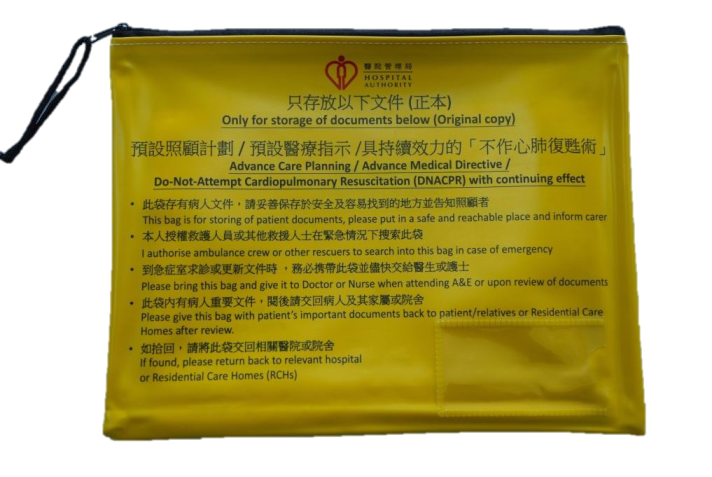
To aid patients in carrying DNACPR orders, the HA will prepare eye-catching designed pouches for their patients (see the photo below). The pouches will be clearly labelled as containing a DNACPR order, permitting rescuers to search for the order therein. We advise that DNACPR orders should be positioned in a highly visible location for easy identification and quick access by family members or rescuers.
 |
Reference Materials
Public
The Hospital Authority – Smart Patient Website (Palliative Care Platform)
Healthcare Professionals